
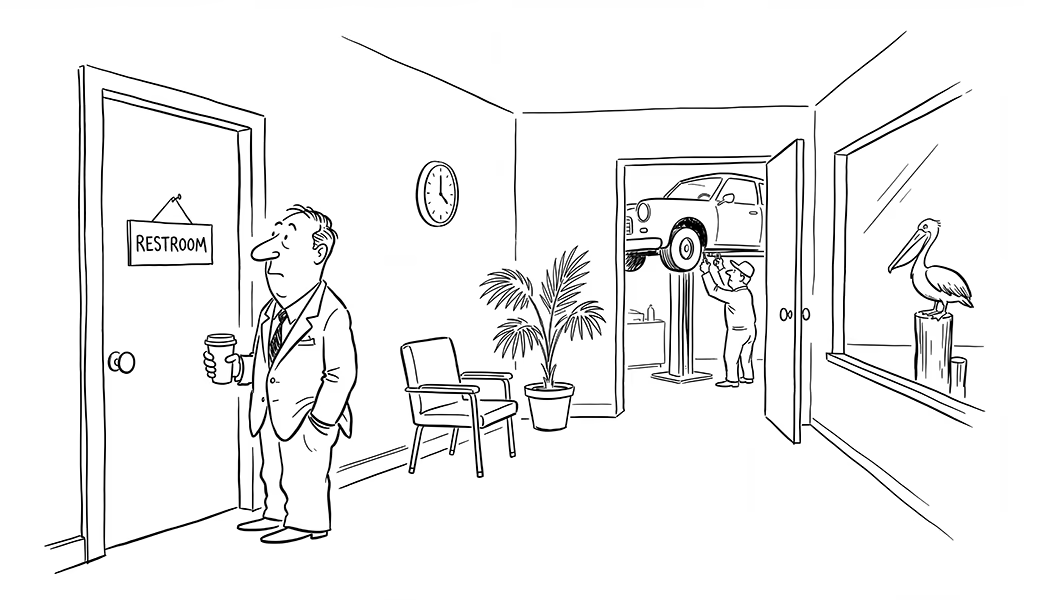
A customer waiting on a brake job or a diagnostic has time to fill. They check their phone, look at the TV, and sooner or later ask where the restroom is. For the next few minutes they stand in the one room of your shop where no one from your staff is watching and every surface is within arm’s reach.
That makes the restroom the closest inspection your shop gets. At the service counter a customer looks at a countertop for a minute. In the restroom they look at the floor, the toilet, the sink, the mirror, and the trash can, and they smell the room before they notice any of it.
What a Customer Sees in Thirty Seconds
Nobody carries a checklist into a restroom, but most people take in the same things in roughly the same order:
- Odor. It registers before the eye takes in anything else. A heavy air freshener tells the customer someone is covering something up.
- The floor around the toilet and under the sink, where dirt and moisture collect first.
- Fixtures: the toilet base and seat, the sink basin, and the faucet handles.
- The mirror and the counter, where splashes and smudges show.
- The trash can and the dispensers. An overflowing bin or an empty soap dispenser reads as a room no one has checked.
- The door handle and the light switch, which each visitor touches.
A shop can do the repair work correctly and still lose a customer’s confidence in this room, because the restroom gives the customer nothing to look at except the condition of the space.
Longer Waits Raise the Stakes
A customer dropping off a car for a quick service may never open that door. A customer waiting through a long diagnostic probably will, and some bring a passenger or a child along who needs it too. Each additional hour in your building adds another chance for a customer to see the restroom, and the restroom leaves little room for error.
The Two-User Problem
Auto shop restrooms serve two very different groups. Technicians come in with grease on their hands and forearms. They use the faucet, the soap and towel dispensers, the door, and the light switch. A few minutes later a customer walks in and uses the same fixtures.
If one restroom serves both groups, the customer is looking at the residue from the last technician’s wash-up. Shops with a separate staff restroom avoid part of this, but grease can still travel on hands to door handles and light switches between the bay and the hallway. Either way, the customer sees the evidence of a working shop in a room where they expect none.
Why the Restroom Slips Between Cleanings
A restroom changes quickly on a busy day. One that looks good in the morning has been used by technicians and customers by afternoon, and the next scheduled cleaning may be hours away.
The cleaning schedule sets the baseline. What happens between visits belongs to your staff, and a few short habits keep the baseline from sliding:
- Check toilet paper, soap, and paper towels at set times during the day.
- Empty the trash before it fills.
- Wipe the faucet and counter after a heavy stretch of technician use.
- Look at the restroom the way a customer would, from the doorway.
These checks take a couple of minutes and do not replace a cleaning service. They cover the gaps a schedule cannot.
What to Settle with Your Cleaning Company
The word restrooms in a cleaning contract can mean a quick pass or a full cleaning. Get the specifics in writing:
- Scope. List the toilets, urinals, sinks, mirrors, floors, dispensers, trash, and touch points such as door handles and light switches.
- Grease spots. Faucet handles, dispenser buttons, and the area around the sink collect residue from technicians’ hands. Ask whether those spots are named in the scope or left to chance.
- Supplies. Decide who stocks soap, paper towels, and toilet paper so no one assumes the other party has it handled.
- Frequency. A shop with heavy customer traffic needs more restroom attention than a quiet one. Ask how the schedule reflects the volume your shop actually sees.
Part of the Service, Not an Afterthought
A customer rarely mentions a clean restroom, and that is the goal. It keeps their attention on the work you did instead of the room they walked through.
If restrooms are an afterthought in your current cleaning scope, our auto shop cleaning services include them with the waiting area, service counter, showroom, and entryway, so every space a customer uses gets the same attention. We also recommend an initial reset clean before recurring service begins, which gives customer-facing areas, restrooms included, a clean starting point instead of a schedule built on top of existing buildup.