
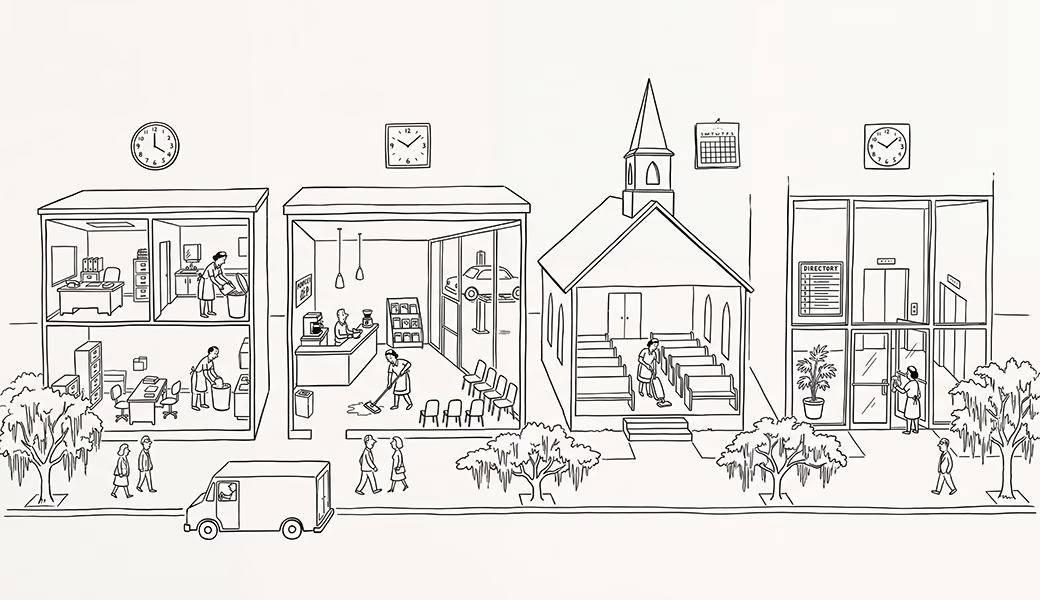
“How often should we be cleaned?” is usually the second question a facility manager asks, right after “what will it cost?” The two are tied together. Frequency drives most of the price of a cleaning contract, and the right frequency depends less on square footage than on who uses the building, how often they use it, and what they expect to find when they walk in.
A church that fills up on the weekend and a dealership showroom that sees customers all day can have similar floor plans and completely different cleaning needs. This guide gives you a starting point by facility type, along with the factors that should move a schedule up or down.
Why Industry Matters More Than Square Footage
Square footage tells you how long a visit takes. It does not tell you how quickly the space gets dirty again. That comes down to three things:
- Traffic pattern: steady use every day, or heavy use concentrated into a few peaks.
- Who sees the space: employees only, or customers, members, and visitors.
- What happens there: working, waiting, eating, gathering.
Two buildings of the same size can need very different schedules. A quiet back office can hold its condition for days. A customer waiting area with a coffee station and a public restroom cannot.
Frequency Reference Table
| Facility Type | Typical Starting Frequency | What Drives It |
|---|---|---|
| Small office (1–6 people) | 1x per week | Low traffic, minimal shared space |
| Mid-size office (7–30 people) | 2–3x per week | Restrooms, kitchen, and common areas |
| Large office (30+ people) | Nightly | High headcount wears down restrooms and kitchens between visits |
| Auto shop and dealership customer areas | 2–3x per week to nightly | Daily public traffic through waiting areas, counters, restrooms, and showrooms |
| Church | Weekly before the main service, plus touch-ups around gatherings and events | Use concentrated around a calendar rather than a workweek |
| Multi-tenant and high-traffic buildings | Multiple times per week to nightly | Shared lobbies, corridors, and restrooms used by several businesses |
| Post-construction | Per project, before occupancy | One-time clean, then a transition to recurring service |
Treat these as starting points, not contract terms. The right schedule for a specific building comes from walking it and seeing how it is actually used.
Offices
Offices are the most common commercial account and the most variable. Headcount, kitchen use, and client traffic set the pace. For most mid-size offices, a recurring office cleaning program two to three times a week covers the essentials. Larger offices, and offices where clients walk through every day, usually need nightly service in at least part of the building.
The break room and restrooms tend to set the floor. Even when the rest of the space could run on a lighter schedule, a shared kitchen often needs attention more often than the desks around it. For a closer look at office schedules by size and use, see our breakdown of how often a commercial office should be cleaned.
Auto Shops and Dealerships
In an automotive facility, the frequency question is really about the customer side of the building: waiting areas, service counters, restrooms, showrooms, and entryways. Those spaces see a steady stream of people every day the doors are open, and a good share of what comes in arrives on the shoes of people who just walked across a service lot.
A busy shop with a full waiting room most of the day will usually need more than two or three visits a week to keep those areas presentable. A smaller shop with lighter walk-in traffic can often hold a good standard at two or three. Either way, auto shop and dealership cleaning works best when it starts from a thorough reset clean, so recurring visits maintain a real baseline instead of chipping away at built-up grime.
Churches
Church use does not follow a workweek. It comes in concentrated waves: the main weekend service, midweek gatherings, and a steady calendar of meals, classes, weddings, and funerals. Frequency for a church is better measured against that calendar than against the days of the week.
A practical baseline is one full clean timed before the main weekly service, with touch-ups before other gatherings and cleanup after events. Fellowship halls deserve their own line in the schedule, since a shared meal can undo a full clean in an afternoon. Seasonal deep cleaning before major holidays brings the building back to a true baseline. Good church cleaning services are built around the church calendar, not the other way around.
Multi-Tenant and High-Traffic Buildings
Shared spaces belong to everyone, which often means no single tenant keeps an eye on them. Lobbies, corridors, elevators, and shared restrooms carry the combined traffic of every business in the building, and they shape every visitor’s first impression of every tenant.
These buildings usually need cleaning multiple times per week at minimum, and nightly service when shared restrooms see use throughout the day. This is the territory commercial janitorial services are built for: a consistent recurring schedule that maintains a standard rather than catching up to one.
Post-Construction: Timing Instead of Frequency
Post-construction cleaning is the exception in this guide. It is tied to a project, not a recurring schedule, so the question is when, not how often. The clean has to land after the dust-producing work is done and before the space opens, with enough margin that a late trade does not undo it.
Planning a post-construction cleaning project early keeps it from getting squeezed against an opening date. Once the doors open, the building moves onto a recurring schedule based on its use, and the guidelines above apply.
What Moves Frequency Up or Down
Within any facility type, a few factors consistently justify adjusting the baseline.
Factors that push frequency up:
- Public or customer traffic through restrooms and waiting areas
- Food in the building, especially full meals rather than coffee and snacks
- Cold and flu season, when high-touch surfaces carry more risk
- Events, trainings, and other high-activity days
Factors that allow frequency down:
- Hybrid schedules that leave the building partly empty on certain days
- Low-use rooms such as storage areas and rarely booked conference rooms
- Private offices used by one person rather than shared workspace
Set Frequency by Area, Not by Building
Most buildings do not need a single frequency. They need several. Restrooms and a busy kitchen may need nightly attention while conference rooms and storage areas need a weekly pass. Applying one schedule to the whole building either overspends on the quiet areas or under serves the busy ones.
A good written scope of work lists tasks and frequencies area by area. If a cleaning company quotes one number for the entire building without walking it first, it is guessing. A walkthrough that asks how each space is used before recommending a schedule is the most reliable way to land on the right frequency, and it tells you a lot about how the company will run your account.