
When most people picture office cleaning, they picture it happening after everyone has gone home. After-hours service has been the default for commercial accounts for decades, and for good reason — an empty building is easier to clean than an occupied one.
But daytime cleaning has grown as an option, particularly for smaller offices and businesses that want more visibility into what is being done and when. Neither schedule is universally better. The right choice depends on how your office operates, what matters most to your staff and clients, and what kind of relationship you want with your cleaning vendor.
Here is a straight look at both options.
How After-Hours Cleaning Works
After-hours cleaning is exactly what it sounds like: the crew arrives after your last employee leaves and completes the full scope before the office opens the next morning. For most commercial accounts, that means a window somewhere between 6 p.m. and 6 a.m., though the specific timing depends on your building, your cleaning company, and the size of the scope.
The main advantage is that the crew can move through the space without working around people. Floors can be vacuumed without disrupting a meeting. Restrooms can be fully serviced without anyone waiting. Surfaces can be wiped down without asking someone to move their laptop. The cleaning happens invisibly, and the office is ready when staff arrive in the morning.
The trade-off is visibility. If something is missed, you may not know until the next day — or until someone complains. Issues that would be caught and corrected immediately during a daytime visit go unnoticed until the next scheduled service or until you reach out to the vendor.
After-hours service also requires your cleaning company to have reliable access protocols in place. Key management, alarm codes, and building security procedures need to be handled carefully. Most established commercial cleaning companies have standard processes for this, but it is worth discussing explicitly before the contract starts.
How Daytime Cleaning Works
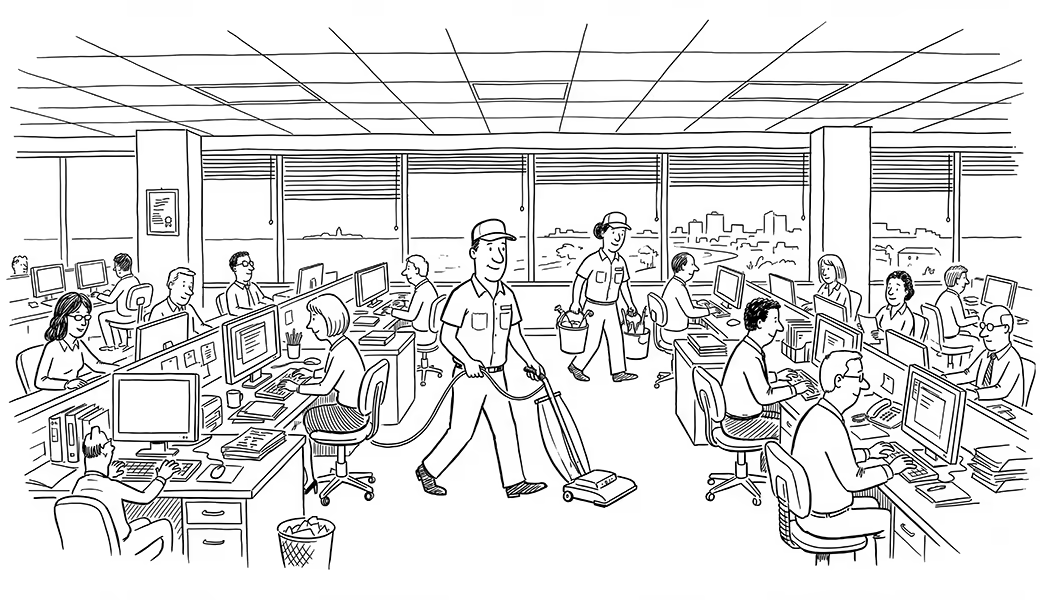
Daytime cleaning schedules the crew during occupied hours — typically mid-morning or early afternoon — to handle routine tasks while the office is in use. This is more common in smaller offices and in facilities where after-hours access is complicated or where the client wants to be present when cleaning occurs.
The visibility advantage is real. You can see what is being cleaned, flag something that was missed while the crew is still on site, and build a more direct working relationship with the people cleaning your space. For some clients, that accountability is worth the mild disruption of having cleaners present during the workday.
The disruption piece is the honest trade-off. Vacuuming in an open office while a call is happening is disruptive. Restrooms taken out of service for cleaning during peak midday hours creates friction. A well-run daytime service minimizes these issues through scheduling and communication, but it cannot eliminate them entirely.
Daytime service also tends to work better for offices with predictable, consistent schedules. If your team’s hours vary, if you have frequent client visits throughout the day, or if your layout makes it difficult to clean around people without interruption, daytime service creates more coordination overhead than it solves.
Side-by-Side Comparison
| Daytime Cleaning | After-Hours Cleaning | |
|---|---|---|
| Supervision | Easier to oversee quality in real time | Requires trust and inspection process |
| Staff disruption | Crews work around employees; some interruption | No impact on occupied workspace |
| Security | Cleaners visible and accountable during hours | Requires after-hours access protocols |
| Accountability | Issues spotted and reported same day | Problems may not surface until next morning |
| Flexibility | Schedule adjusts easily around office activity | Fixed window; changes require coordination |
| Best for | Smaller offices, open environments, trust-focused clients | Larger facilities, client-facing spaces, regulated environments |
Factors That Point Toward After-Hours
- Larger headcount: The more people in the space, the more disruption daytime cleaning creates. Offices with 20 or more people generally run more smoothly with after-hours service.
- Client-facing environment: If clients visit regularly, you want the space looking its best throughout the day without the visual of a cleaning crew moving through during business hours.
- Open floor plan: Vacuuming and mopping an open layout while people are working is difficult to do without disrupting multiple people at once.
- Regulated or sensitive environments: Medical offices, financial services firms, and legal practices often have access and confidentiality considerations that make after-hours service the cleaner operational choice.
- Preference for invisibility: Some clients simply want the cleaning to happen without any awareness of it. After-hours service delivers that completely.
Factors That Point Toward Daytime
- Small team: A six-person office with a single open room and one restroom can be cleaned quickly and with minimal disruption during a slow midday hour.
- Building or security constraints: Some commercial buildings restrict after-hours access, require escorted entry, or have alarm systems that make unsupervised evening access complicated.
- Desire for direct oversight: If you want to be present when cleaning happens and maintain a closer eye on what is done, daytime service makes that practical.
- Irregular or extended hours: If your office runs late regularly or has unpredictable end times, defining a reliable after-hours window for the cleaning crew can be difficult. A daytime slot is easier to hold consistently.
Hybrid Schedules
Some offices split the difference. Routine tasks — trash, restrooms, quick surface wipes — are handled during a short daytime visit, while deeper cleaning like vacuuming, mopping, and full kitchen service happens after hours on a less frequent basis.
This works well for mid-size offices that want daily visible maintenance without the cost of a full nightly crew. It requires a cleaning company comfortable managing a split schedule and communicating clearly about what gets done in each visit.
If a hybrid approach sounds like it fits your situation, it is worth raising during your walkthrough. Not every company offers it, but those that do can often build a schedule that is more precisely matched to how your office actually operates.
The Right Answer Depends on Your Office
There is no universally correct answer between daytime and after-hours cleaning. The right choice depends on your headcount, your layout, your hours, your building’s access situation, and how much you want to see the work happen versus simply see the results.
When we do a walkthrough for a new commercial account, scheduling is one of the first things we discuss. We build the service around how the office actually operates — not around a default that may not fit.