
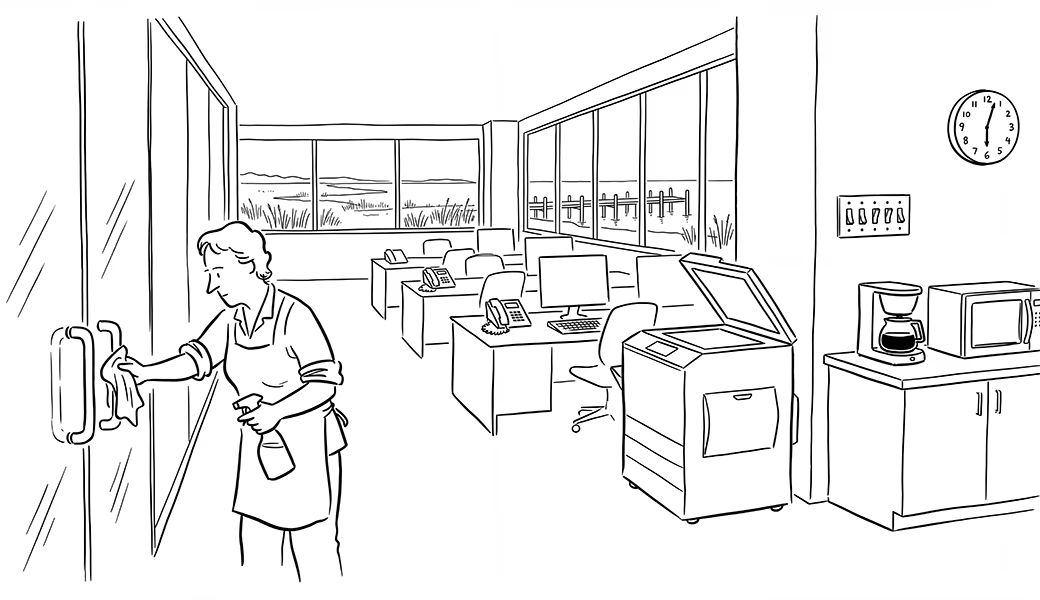
High-touch surface cleaning shows up in almost every commercial cleaning proposal, usually as a single line near the bottom of the list. It sounds self-explanatory, and that’s the problem. Without a clear definition, it can mean anything from a careful disinfecting routine to a quick pass over the front door handle on the way out. Knowing what the term should cover — and what separates doing it properly from doing it for appearances — makes it much easier to tell whether your office is actually getting it.
What Counts as a High-Touch Surface
A high-touch surface is anything several different people put their hands on over the course of a normal workday. Door handles and light switches are the obvious examples, but the full list in a typical office runs much longer:
- Entry doors, push plates, and interior door handles
- Light switches and elevator buttons
- Breakroom appliance handles — refrigerator, microwave, coffee maker
- Faucet handles, soap dispensers, and paper towel dispensers
- Shared phones, printers, copiers, and conference room equipment
- Stair rails and handrails
- Chair armrests and conference table edges
- Reception counters and visitor sign-in areas
What these surfaces have in common isn’t how dirty they look. Most of them look clean nearly all the time. What they share is contact frequency — the number of different hands that touch them between one cleaning and the next. That’s the measure that should decide what goes on the list, not appearance.
Cleaning, Sanitizing, and Disinfecting Aren’t the Same Thing
These three words get used interchangeably, but they describe three different jobs.
Cleaning removes dirt, oils, and residue from a surface. It doesn’t necessarily kill anything, but it physically removes much of what’s there and prepares the surface for the next step.
Sanitizing reduces the number of germs on a surface to a lower level generally considered safe by public health standards.
Disinfecting uses a product registered for that purpose to kill the germs listed on its label, when it’s used as the label directs.
The order matters. Disinfectant works poorly on a surface still coated in fingerprints, grime, or residue, which is why proper high-touch work starts by cleaning the surface and then disinfecting it — rather than going straight to the spray bottle and calling it done.
Contact Time Is the Step Most Often Skipped
Every disinfectant has a contact time printed on its label, sometimes called dwell time. It’s the length of time the surface has to stay visibly wet for the product to do what the label claims. That time varies from product to product, and some require several minutes.
Spraying and wiping in one motion removes the product before it has had a chance to work. The surface smells clean and looks clean, but in practice it was only wiped. Disinfecting that actually does its job accounts for contact time: apply the product, leave the surface wet for the full time listed on the label, then wipe if the label calls for it.
Technique Matters as Much as the Product
A good disinfectant used carelessly can do more to spread germs than to remove them. Three habits make the difference.
Cloth handling. A single cloth carried from a restroom to the breakroom to the front desk moves germs from one surface to the next. Switching to fresh cloths, or fresh cloth faces, as work moves between surfaces and areas keeps the cleaning from turning into a delivery route.
Shared electronics. Keyboards, desk phones, and touchscreens generally shouldn’t be sprayed directly, since liquid can work its way into openings. Applying the product to a cloth first, and following the equipment manufacturer’s cleaning guidance, protects both the surface and the device.
Full coverage. Hands don’t only touch the obvious spot. A door gets handled on both sides, a push bar gets gripped along its length, and a copier gets touched on its control panel, paper trays, and lid. High-touch cleaning should follow where hands actually go, not just the most visible point.
How Often High-Touch Surfaces Need Attention
Frequency should follow traffic, not appearance. An office with a busy entrance, a shared breakroom, and a copier in constant use needs its high-touch points addressed every service visit. Lower-traffic areas, like a rarely used storage room, can follow a lighter schedule. Seasonal changes in illness, such as cold and flu season, are a reasonable time to revisit whether the current cadence still fits how the space is being used.
If you’re working through how often a commercial office should be cleaned overall, high-touch surfaces are usually where the schedule needs the most frequency, even when other tasks can run on a lighter rotation.
What to Ask Your Cleaning Provider
Because high-touch cleaning is so easy to list and so hard to see, it’s worth asking a few direct questions:
- Which specific surfaces in our space are on your high-touch list?
- Are those surfaces cleaned before they’re disinfected?
- What product do you use, and how do your crews handle its contact time?
- How are cloths separated between restrooms and other areas?
- How do you handle shared electronics?
A provider who does this work properly can answer each of these without hesitation. If the answer to all of them is some version of “we wipe everything down,” that tells you what’s really happening after hours.
Where It Fits in a Cleaning Program
High-touch surface cleaning isn’t a separate service so much as a standard that should run through every visit. At Next Level, disinfecting high-touch areas is built into our office cleaning services, alongside trash removal, floor care, restroom sanitation, breakroom cleaning, and dusting. The goal is simple: the surfaces your team touches most are the ones that get handled with the most care.