
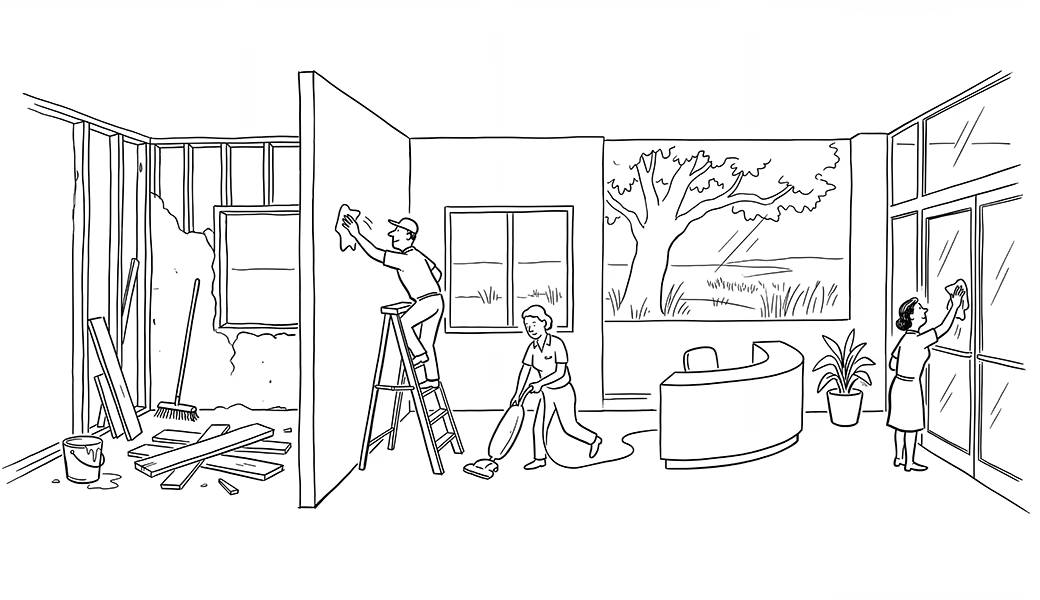
A construction project does not end with one cleaning. It ends with a sequence of them. The reason is simple: dust and debris keep being created until the last trade leaves the building, and every surface cleaned before that point is at risk of being covered again.
Post-construction cleaning is usually organized into three phases: the rough clean, the final clean, and the touch-up clean. Each has a different purpose, a different place in the project schedule, and a different definition of done. Understanding all three helps general contractors, developers, and business owners set cleaning dates that hold up instead of dates that have to be redone.
Why a Single Cleaning Rarely Works
Construction dust is fine, light, and persistent. It settles on horizontal surfaces, collects in vents, and clings to walls and window frames. Then the next trade arrives to cut, sand, drill, or install, and the cycle starts over.
A single cleaning at the end of a project has to handle everything at once: leftover materials, heavy dust, sticky residue, and the fine detail work that makes a space look finished. Splitting that work into phases lets each pass happen at the point in the schedule where it will actually last.
Phase One: The Rough Clean
The rough clean comes after the messiest work is done and before finish work begins. Its job is to clear the way. Leftover materials, packaging, and scraps come out, and heavy dust and grit come off floors and surfaces so the trades that follow are working in a space that is workable rather than buried.
Think of it as a reset, not a polish. Nobody expects a space to look clean after a rough clean. The goal is a clear, debris-free starting point for painters, flooring installers, and fixture crews. Skip it, and fine dust from earlier work ends up on and around new finishes, in places that are much harder to reach later.
Phase Two: The Final Clean
The final clean happens after construction work is complete and before the space is handed over. It is the phase most people picture when they hear post-construction cleaning, and it is the most detailed of the three.
Work generally moves from the top of the space down, so dust falls onto surfaces that have not been cleaned yet rather than ones that already have. Typical scope includes:
- Construction dust removal from walls, surfaces, vents, and floors
- Interior windows and first-floor exterior windows
- Floor cleaning and remaining debris removal
- Surface cleaning and wipe-downs throughout the space
Exact scope depends on the project. A tenant buildout and a new-build shell are not the same job, so scope is defined at the walkthrough, before any work begins.
Phase Three: The Touch-Up Clean
Even a thorough final clean has one weakness: time. Between the end of the final clean and the day the doors open, people keep walking the space. Punch-list items get finished. Owners, inspectors, and future tenants tour the building. Each of those steps leaves something behind: fingerprints, footprints, a fresh layer of settled dust, a smudge on a newly hung door.
The touch-up clean closes that gap. It is a shorter, lighter pass, timed as close to occupancy as the schedule allows and focused on final detailing. It covers the surfaces people see and touch first, which makes it the phase that shapes the first impression for a customer, tenant, or employee walking in.
How to Build the Phases Into Your Schedule
Cleaning dates are easiest to set when you work backward from the opening or handoff date. A few practical points:
- Place the rough clean between the heavy trades and the finish trades, not at the end of the project.
- Schedule the final clean after trade work is finished, not while work is still happening in the space.
- Hold the touch-up clean until punch-list work is complete, and keep it as close to occupancy as possible.
- Confirm which phases the project needs. A smaller renovation may combine phases into fewer visits, while a larger build may keep all three separate.
Cleaning that gets squeezed into the last day before opening is the cleaning most likely to be rushed. Building it into the schedule early protects both the opening date and the quality of the result.
Questions to Ask Before You Hire
Any cleaning company can quote a post-construction job. The answers to these questions show whether the quote matches the way your project actually runs:
- Which phases does the quote cover, and which are priced separately?
- Where in the project timeline will the crew be on site for each phase?
- What is included in the scope, and what is not?
- What happens if punch-list work creates new dust after the final clean?
- Will there be a walkthrough of the space before pricing is finalized?
From Handoff to Ongoing Service
Once the space is clean and occupied, the work does not have to stop. A crew that has cleaned a building through construction already knows its floors, its finishes, and its problem areas. That familiarity is why many post-construction projects lead naturally into recurring cleaning contracts.
If you have a project coming up, our post-construction cleaning service starts with a no-obligation walkthrough, so the phases, scope, and timing are settled before the first day on site.