
An auto shop floor looks like concrete, and concrete looks simple to clean. In practice, shop floors are one of the more demanding surfaces in commercial cleaning — not because the material is complicated, but because of what ends up on it and how deeply it gets absorbed.
Standard commercial cleaning approaches, the kind built for offices and retail spaces, do not translate well to a working shop floor. Understanding why helps explain what a cleaning service actually needs to do differently in an automotive environment.
Porous Concrete Absorbs What You Can’t See
Concrete is porous. Under a microscope, the surface is full of small voids that liquids can penetrate rather than sit on top of. In an office, that porosity is rarely tested — spills are quickly wiped up and rarely involve anything that stains deeply. In a shop, oil, transmission fluid, brake fluid, and coolant all get walked across the floor repeatedly before anyone notices a spill happened.
Once oil or grease penetrates the surface of unsealed or lightly sealed concrete, surface cleaning does not remove it. The stain and the residue are below the surface, not on it. This is why shop floors that get mopped regularly can still look and feel oily — the mopping is cleaning the top layer while the absorbed contamination stays put.
Sealed concrete resists this significantly better, but even sealed floors accumulate grime in high-traffic zones — under lifts, around workstations, at entry points — faster than the seal can shed it with routine cleaning alone.
Standard Cleaning Products Aren’t Built for the Job
General-purpose commercial cleaning products are formulated for surface dirt, dust, and light organic residue — the kind of soil that accumulates in an office or retail environment. They are not formulated to break down petroleum-based contamination.
De-greasing a shop floor requires products specifically designed to emulsify oil and grease so they can be lifted and rinsed away rather than just spread around. Using a standard all-purpose cleaner on a heavily contaminated shop floor typically just moves the grime from one area to another without actually removing it — and can make the floor more slippery in the process.
This is one of the most common gaps when a shop tries to use a general commercial cleaning service instead of one that understands automotive environments. The crew shows up with standard supplies, and the results do not hold up because the products were never designed for this kind of soil.
Traffic Patterns Concentrate the Problem
Shop floors do not wear evenly. The areas under lifts, around workbenches, and near high-use equipment take far more contamination than open floor space. Employees and customers walk directly through these zones, tracking residue further into the shop and toward customer-facing areas like the waiting room or front office.
Effective shop floor cleaning has to account for this unevenness — treating high-contamination zones differently and more frequently than open floor areas, rather than applying a uniform cleaning approach across the entire space.
Standing Water & Slip Risk
Shop floors also carry a safety dimension that most commercial floors do not. A wet floor sign in an office is a minor inconvenience. A wet or oily floor in a shop, where employees are moving around vehicles, lifts, and tools, is a real safety hazard.
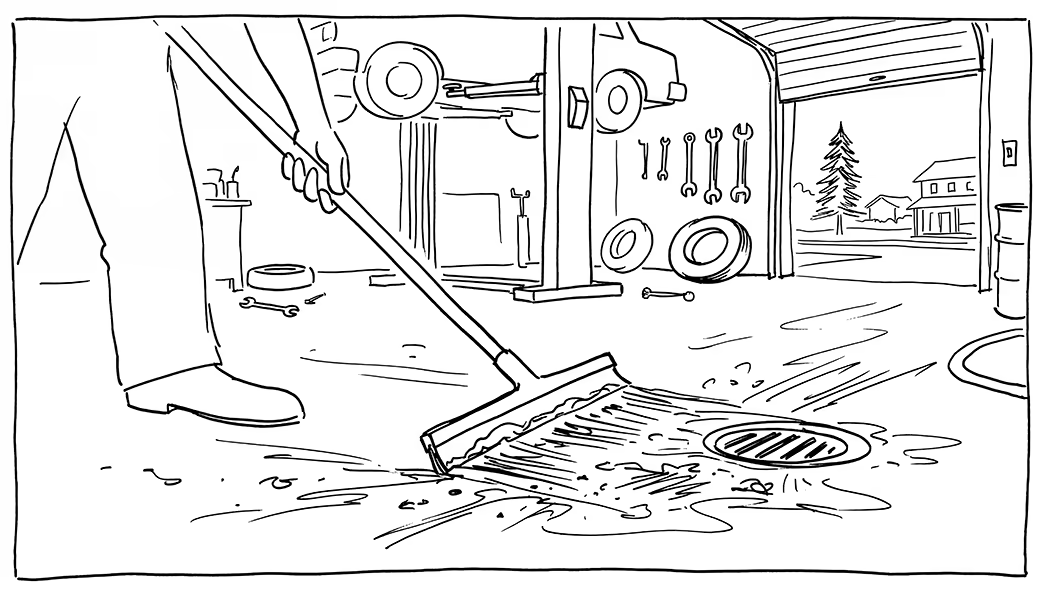
Cleaning methods that leave standing water or residual moisture on a shop floor create slip risk that persists until the floor fully dries — which can take longer in a shop environment with less airflow and ventilation than an open office. Proper technique includes managing water usage and ensuring floors are squeegeed or otherwise cleared rather than left to air dry on their own.
What Effective Shop Floor Cleaning Actually Looks Like
- De-greasing agents matched to the contamination: Petroleum-based stains require petroleum-specific degreasers, not general-purpose cleaners.
- Mechanical agitation: Scrubbing, whether by hand or with mechanical equipment, is often necessary to work degreaser into contaminated areas rather than relying on the product alone.
- Zone-based attention: High-contamination areas under lifts and around workstations get treated more frequently and more aggressively than open floor space.
- Proper rinse and extraction: De-greased residue needs to be rinsed and removed, not just loosened and left behind.
- Water management: Standing water gets squeegeed or extracted rather than left to dry naturally, reducing slip risk and speeding up the time before the floor is safely usable again.
Why This Matters Beyond Appearance
A clean shop floor is not just about looking presentable to customers, though that matters. It affects safety for employees working around vehicles and equipment daily. It affects how long the floor sealant and surface hold up over time — unaddressed contamination degrades concrete faster than regular, correct cleaning does. And it affects the overall impression the shop makes on customers who are trusting the business with an expensive piece of their property.
A shop that looks clean and smells clean, rather than masking odor with air freshener over an oily floor, signals a level of operational care that customers notice even if they can’t articulate why.
Cleaning Built for the Environment
General commercial cleaning services that have not worked in automotive environments often underestimate what shop floors require. The right approach uses de-greasing products matched to the contamination, treats high-traffic zones differently than open space, and manages water properly to avoid creating a slip hazard.
Our auto shop cleaning services are built around what shop floors actually need, not a generic commercial cleaning template applied to a different kind of space.