
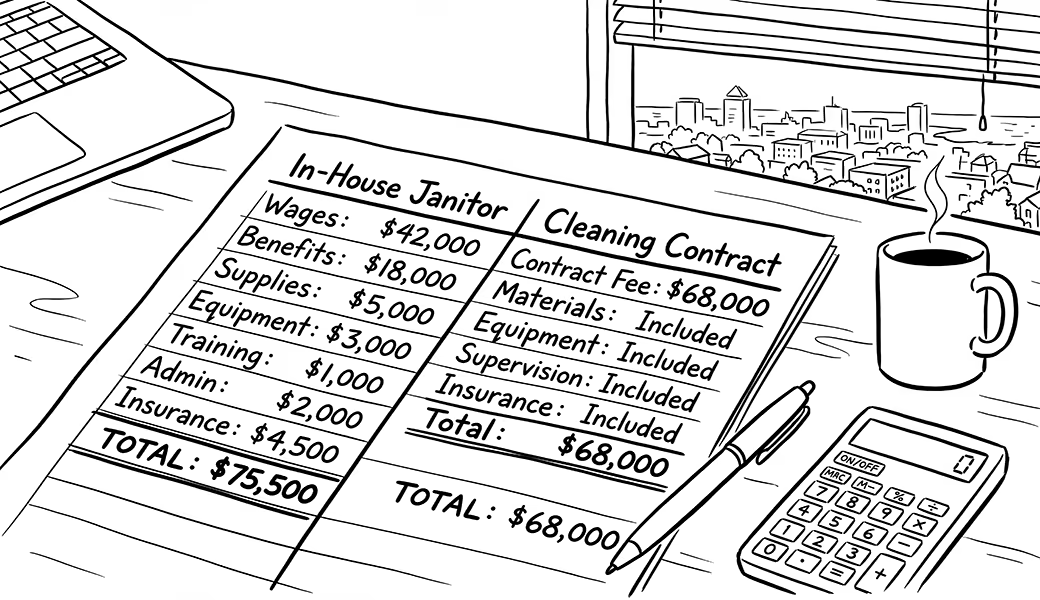
At some point most facility managers run the same mental calculation: would it be cheaper to hire someone directly rather than pay a cleaning company every month? On the surface the math seems straightforward. A part-time janitor at $15 an hour, a few hours a night, adds up to a number that looks smaller than a commercial cleaning contract.
The surface number is almost never the real number. An in-house janitor comes with a set of costs, responsibilities, and operational demands that a cleaning contract transfers to the vendor. Once those are accounted for, the comparison looks different — and for most commercial facilities, the contracted route is both less expensive and less work.
Here is a direct look at what each option actually costs.
The Visible Costs of an In-House Janitor
The starting point is wages. A full-time commercial janitor in North Carolina earns roughly $30,000 to $42,000 annually depending on experience and hours. Part-time arrangements cost less in base wages but introduce their own complications around scheduling, coverage, and reliability.
On top of wages, every employee comes with employer-side costs that add 20 to 30 percent to the base wage figure:
- Payroll taxes: Employer share of Social Security and Medicare runs 7.65 percent of gross wages on every dollar paid.
- Workers’ compensation insurance: Janitorial workers fall into a higher-risk classification than office employees. Rates vary but the premium is real and it is your policy, not someone else’s.
- Health benefits: For full-time employees, employer health contributions have become a competitive expectation. Even a modest contribution adds several thousand dollars annually per employee.
- Paid time off: Vacation, sick leave, and holidays mean you are paying for days the work does not get done — and arranging coverage when they occur.
Before a single restroom gets cleaned, the fully loaded cost of an in-house janitor is meaningfully higher than the base wage suggests.
The Hidden Costs That Don’t Show Up in the Wage
Wages and benefits are the visible line items. There is a second layer of costs that does not appear on a payroll report but is very real in terms of time and money.
- Equipment and supplies: Mops, vacuums, floor scrubbers, cleaning chemicals, trash liners, paper products — all purchased and restocked by you. A contracted service includes these in the rate.
- Hiring and onboarding: Posting the job, screening applicants, running background checks, and onboarding a new employee takes management time. When turnover occurs — and in this industry it does — you repeat the process.
- Supervision: An in-house janitor is your employee. Quality control, performance management, scheduling, and accountability all fall to your management structure. A contracted service handles its own supervision.
- Coverage gaps: When your janitor calls in sick, takes vacation, or leaves, the cleaning either does not happen or you scramble to cover it. A cleaning company provides a substitute without the problem becoming yours to solve.
- Training and compliance: OSHA requirements, chemical handling training, and safety documentation are your responsibility for your own employees. A cleaning vendor manages compliance for its own staff.
Side-by-Side Cost View
| Cost Category | In-House Janitor | Contracted Service |
|---|---|---|
| Base wages | Paid by you; typically $30,000–$42,000/yr full-time | Included in contract rate |
| Payroll taxes | Employer share: ~7.65% of wages | Vendor’s responsibility |
| Health benefits | Required for full-time employees in many cases | Vendor’s responsibility |
| Workers’ comp | Your policy; rates vary by classification | Vendor’s policy |
| Equipment & supplies | Purchased and maintained by you | Included in contract |
| Hiring & training | Your time and cost; repeated on turnover | Vendor’s responsibility |
| Supervision | Your management time | Vendor’s responsibility |
| Coverage when absent | You arrange or go without | Vendor provides substitute |
| Liability exposure | Employer liability for on-site injuries | Transfers to vendor (if insured) |
Where In-House Starts to Make Sense
There are scenarios where an in-house position makes operational sense despite the higher cost. Large facilities — typically over 100,000 square feet — often benefit from having dedicated on-site staff who know the building intimately and can respond to issues throughout the day. Manufacturing environments, hospitals, and large institutional settings commonly run in-house custodial departments for exactly this reason.
Day porter arrangements — a dedicated daytime presence for restroom checks, spill response, and lobby maintenance — are another context where an in-house role can complement a contracted nightly service rather than replace it.
For most commercial offices, retail spaces, medical suites, and mid-size facilities, the volume of work does not justify the overhead of a direct employee. The contracted model provides the same result at lower true cost and with less management burden.
What the Contract Rate Actually Buys
A commercial cleaning contract is not just paying someone to push a mop. The rate covers labor, supervision, equipment, supplies, insurance, training, scheduling, and the vendor’s management overhead. When you account for what is bundled into that rate, the per-hour comparison to an in-house wage is not apples to apples.
It also covers something that does not have a line item: accountability structure. A cleaning company with a quality control process, a direct communication channel, and a financial incentive to retain your account is a different arrangement than a single employee who may or may not share your standards for what clean looks like.
The question worth asking is not “Which option costs less per hour?” It is “What does each option actually deliver over twelve months, and what does it cost in total — including management time, supplies, insurance, and turnover?” When that calculation is run honestly, the contracted service wins for most commercial facilities.
Making the Right Call for Your Facility
If you are currently running the in-house vs. contract calculation for your facility, the most useful step is to get a cleaning quote and compare it against your fully loaded janitor cost — wages plus taxes plus benefits plus supplies plus your own management time. Most facility managers who do this math honestly find the gap is smaller than expected or runs the other direction entirely.
Our janitorial services are built for commercial facilities that want consistent, accountable cleaning without the overhead of a direct hire. We are straightforward to work with and easy to reach when something needs attention.