
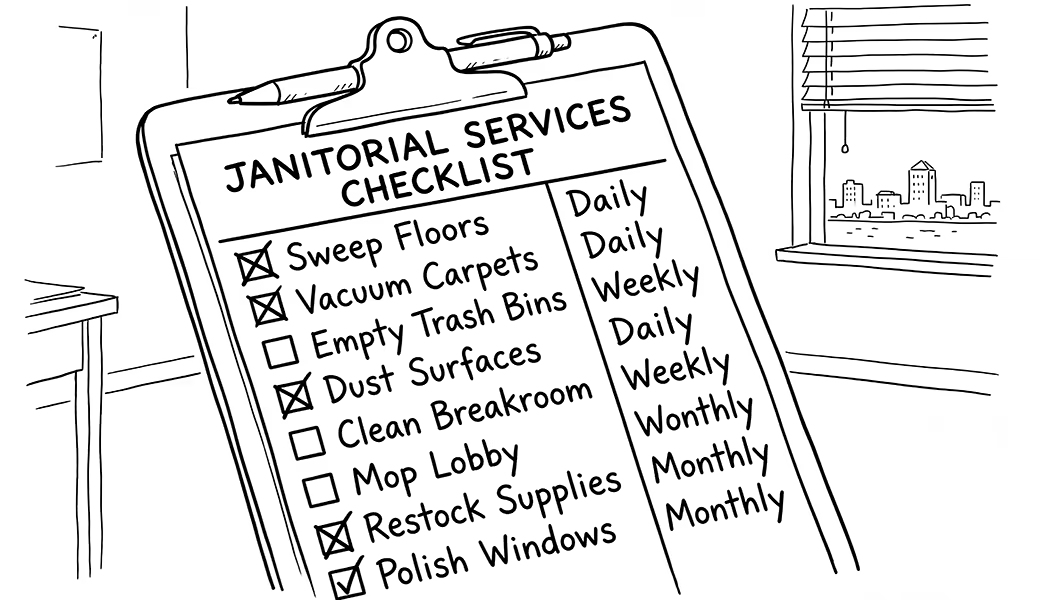
Janitorial services means something different to every company that offers them. One vendor’s standard agreement includes nightly floor care and weekly deep cleaning. Another vendor’s standard agreement, priced similarly, covers trash and restrooms and little else.
Without a clear breakdown of what is included, you are not comparing janitorial agreements — you are comparing prices attached to undefined services. This post lays out what a complete janitorial agreement typically covers, broken down by task and frequency, so you know what to expect and what to ask for.
The Core Service Categories
Most janitorial agreements are built around a handful of core categories: trash and recycling, restrooms, floor care, kitchens and break rooms, dusting, high-touch surface disinfection, and upholstery. How each category is scoped — what specific tasks, how often — is where agreements differ most.
A vague agreement might simply list “restrooms cleaned.” A complete one specifies that toilets and urinals are scrubbed and disinfected, sinks and counters wiped down, mirrors cleaned, floors mopped, and paper products and soap restocked — every visit, not occasionally.
The table below shows a typical task breakdown for a standard commercial janitorial agreement.
| Trash & recycling | Nightly | Empty all receptacles, replace liners, remove to designated collection area |
|---|---|---|
| Restrooms | Nightly | Clean and disinfect fixtures, mop floors, restock paper products and soap |
| Floors — hard surface | Nightly sweep / weekly mop | Sweep and spot-mop nightly; full wet mop on a set weekly schedule |
| Floors — carpet | 2–3x weekly | Vacuum high-traffic areas; full vacuum on a set schedule |
| Kitchens / break rooms | Nightly | Wipe counters, clean sink, empty trash, spot-clean appliance exteriors |
| Dusting | Weekly | Desks, shelving, window sills, accessible horizontal surfaces |
| High-touch surfaces | Nightly | Door handles, light switches, elevator buttons, handrails |
| Glass & entryways | Weekly | Interior glass doors and partitions, entryway glass |
| Upholstery | As scheduled | Office furniture and seating cleaning per agreed schedule |
What’s Often Left Out
Several tasks are commonly excluded from standard janitorial agreements. Knowing what is typically outside the scope prevents surprises after the contract starts.
- Exterior window washing: Almost always a separate service requiring different equipment and access considerations.
- Pressure washing exterior walkways: Outside the scope of interior janitorial service.
- Specialized equipment cleaning: Areas with sensitive or technical equipment often require protocols that fall outside standard janitorial scope. Raise these during the walkthrough.
None of these exclusions are unreasonable. The problem arises when a client assumes a task is included because it seems like it should be, and discovers otherwise only when it does not happen.
Supplies: Who Provides What
Janitorial agreements should specify who supplies consumables — paper towels, toilet paper, hand soap, trash liners. Some agreements include restocking consumables as part of the service but require the client to purchase and provide the products. Others include both the labor and the supplies in the contract rate.
This distinction affects your total cost comparison. A lower contract rate that requires you to separately purchase and supply paper products and soap is not necessarily cheaper than a higher rate that includes those costs. Confirm this explicitly before comparing pricing across vendors.
Specialty Areas
Facilities with specialized spaces — server rooms, areas with sensitive equipment, or environments with specific cleaning requirements — should be discussed explicitly during the walkthrough. A complete agreement addresses these areas directly: what methods are used, what products are approved, and whether any spaces require a different approach than the standard scope.
If your facility includes areas like this, raise them before the contract is signed rather than after the first clean. A vendor that asks about specialty areas proactively is paying attention to the details that determine whether the service actually fits your facility.
Quality Standards and Inspection
A complete agreement describes not just what gets done but how quality is verified. Does the vendor conduct regular supervisory walkthroughs? Is there a checklist system that documents completed tasks? How are issues identified and corrected before you have to report them?
Some agreements include scheduled quality reviews with the client — a periodic walkthrough together to confirm performance and address concerns. This is worth asking for if it is not already part of the standard agreement.
How to Read an Agreement Before You Sign
When reviewing a janitorial services agreement, go through it task by task rather than reading it as a general description. For each category — trash, restrooms, floors, kitchens, dusting, high-touch surfaces, upholstery — confirm the specific frequency and exactly what is included.
Ask directly about anything not mentioned: supply responsibility, specialty area protocols, and how quality is monitored. A vendor that answers these questions specifically and confidently is operating with the kind of clarity that produces consistent service. A vendor that gives vague answers is signaling how the relationship will likely go once the contract starts.
A Clear Agreement Protects Both Sides
A detailed janitorial agreement is not bureaucratic overhead. It is the document that defines what you are paying for and gives you a basis for accountability if something is not being done.
It also protects the cleaning company from unreasonable expectations about tasks that were never part of the scope.
Our janitorial agreements specify tasks and frequencies by area, clarify supply responsibility upfront, and include regular quality walkthroughs. If you are reviewing a current agreement or evaluating a new vendor, we are glad to walk through what a complete scope looks like for your facility.